

The GoPro HERO13 Black does not represent a massive leap in raw sensor resolution (it maintains the same 1/1.9-inch format with an 8:7 aspect ratio as the HERO12), but it resolves practically all the operational complaints of the previous generation and adds an ecosystem that makes it a much more modular tool.
The Smart Lens Ecosystem (HB Series)
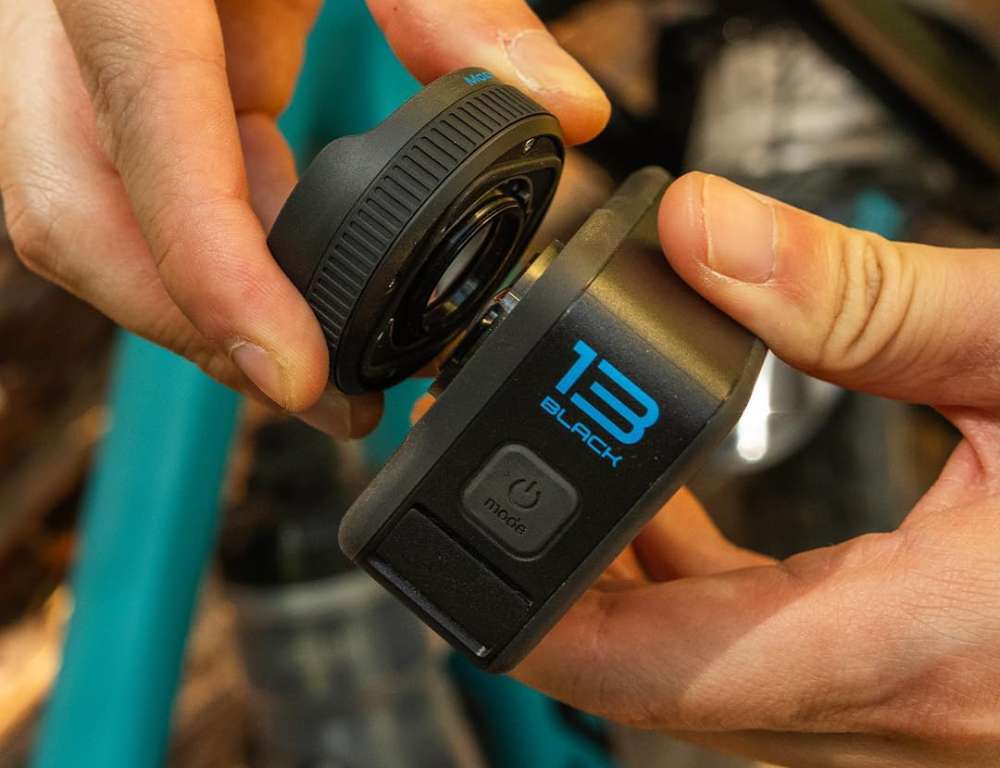
The most significant change is how the camera interacts with the lens. The new HB Series lenses aren’t just physical accessories; the camera automatically detects them when you screw them on and adjusts the color profile, aspect ratio, and stabilization without you having to touch the menus.
- Macro Lens: Reduces the minimum focusing distance by almost 4x, solving the long-standing problem of GoPro blur when recording close-up subjects.
- Ultra Wide Angle Lens: Expands the field of view to 177°.
- ND Filters with Auto-Setting: The camera detects which ND filter you’ve attached (ND4, ND8, ND16, or ND32) and automatically adjusts the shutter speed to achieve that cinematic motion blur effect without overexposing the image.
Physical Redesign: Battery and Mounts
GoPro finally yielded to the competition and modernized its mounting and power system:
- Magnetic Mount: It incorporates a magnetic mount with an integrated latch on the base for quick accessory changes. Thankfully, they didn’t remove the classic folding legs or the 1/4-20 tripod thread, so you have three native mounting options.
- New Enduro Battery: At 1900 mAh, it offers 10% more capacity and improved thermal efficiency. The downside: The physical redesign means your HERO12, 11, or 10 batteries are no longer compatible with this model.
- Magnetic Power: There’s a new side-door accessory that allows you to connect a magnetic cable for continuous charging without exposing the USB-C port to the elements (maintaining its waterproof rating), ideal for long timelapse sessions or webcam use.
Video and Software Performance
Although the sensor is the same, the processor offers new capabilities geared towards post-production:
- HLG HDR Video: Now supports Hybrid Log Gamma, a much more robust HDR standard for monitors compatible with the Rec. 2100 color space, offering a more flexible dynamic range for color grading.
- Burst Slo-Mo: Can capture 400 fps at 720p, or an impressive 120 fps at 5.3K resolution. The technical limitation is that it only sustains this speed for very short bursts (5 to 15 seconds) due to thermal stress and SD card write speed.
- GPS Returns: After being removed in the HERO12 to save battery, the GPS chip returns in the HERO13. This allows you to add telemetry data overlays (speed, altitude, G-force, route map) directly in editing.
| Component | capacity |
| Maximum Resolution | 5.3K a 60 fps / 4K a 120 fps |
| Image Sensor | CMOS de 1/1.9″ (Relación 8:7) |
| Stabilization | HyperSmooth 6.0 |
| Color Depth | 10 bits |
| Connectivity | Wi-Fi 6 (40% faster video transfers to mobile) |
If your goal is simply to record in 4K while cycling and you already have a HERO11 or HERO12, upgrading just for pure image quality doesn’t make much sense.
However, if you do technical editing or scale your production, the HERO13 Black truly shines in the operational workflow. Automatic ND filter detection, magnetic charging, Wi-Fi 6 for quickly emptying heavy cards, and magnetic docking make it a much more professional and less frustrating tool for everyday use.